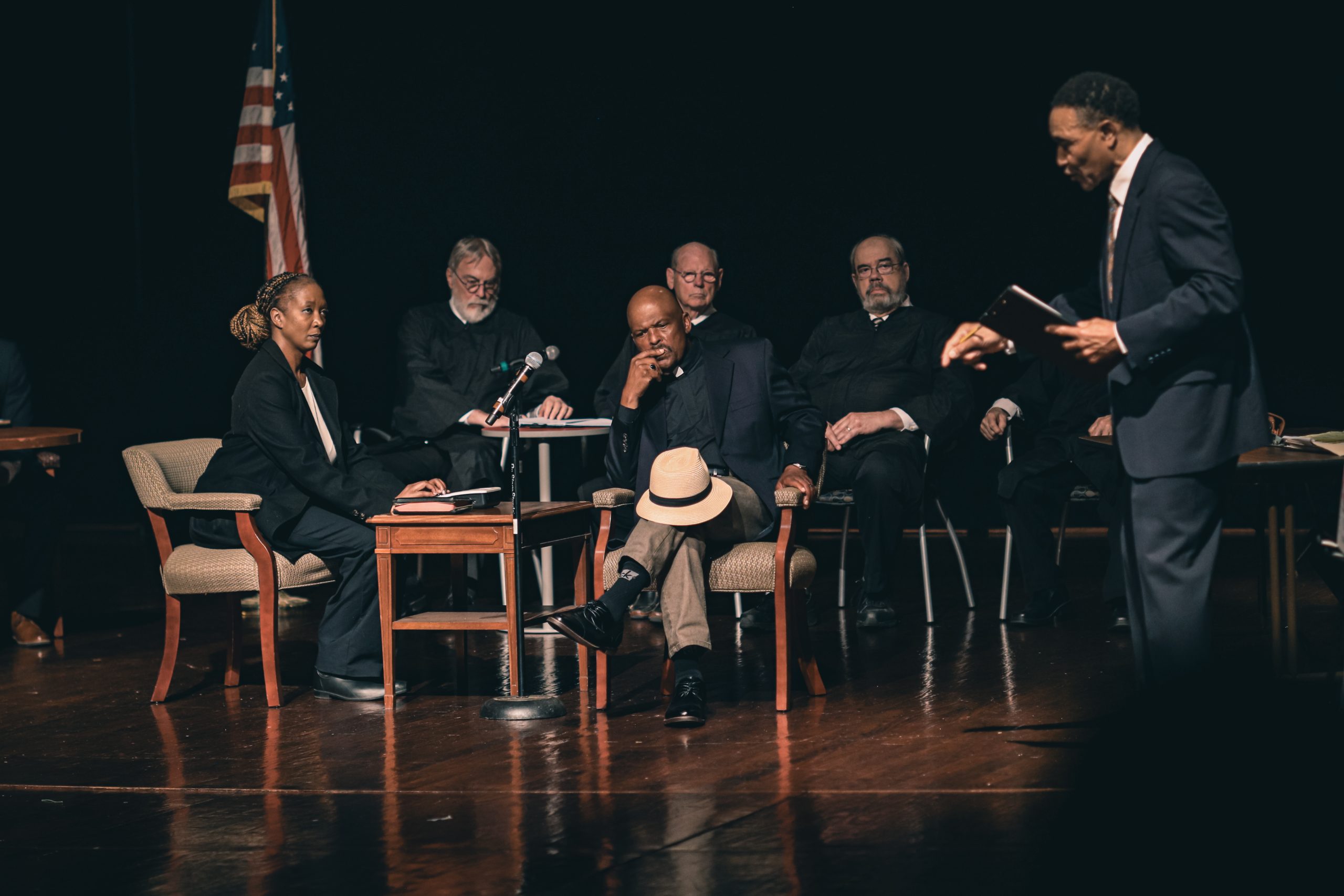
Dr. Cindy Acker, head of school, consultant and keynote speaker reflects on her latest work, a stage play about Brown v. Board of Education. She took some time to chat with the Montessori Post in March, 2026.
What inspired you to write the play Words That Made the Difference: Brown v Board of Education, and what can you tell our readers about it? My parents were from Kansas: my mom from Topeka, and my dad from Kansas City. My mom proudly graduated eighth grade, and my dad, who was illiterate, never spoke about school. My parents were adamant that I study and read as much as possible, but I was always curious about their hesitation to discuss their education with me. After they died, I started to do some research about education in Kansas, and discovered the history of desegregation that occurred in states in and around the south, and the unanimous decision of Brown v. Board of Education in 1954.
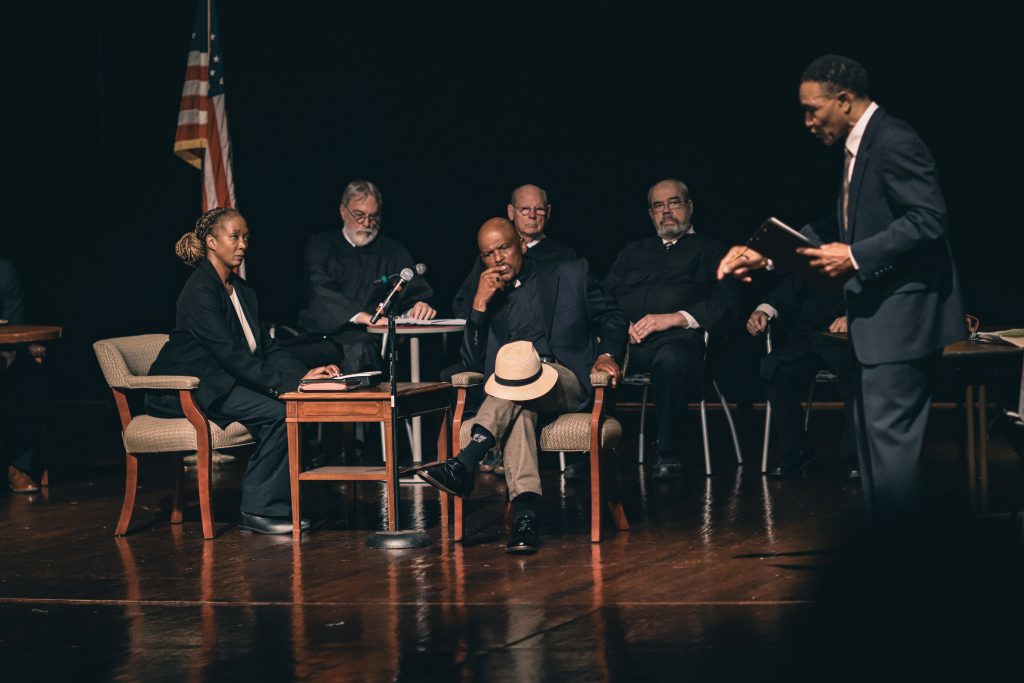
My original thought was to turn the information into a play for my elementary students. However, I was approached by the granddaughter of Supreme Court Justice Earl Warren, who offered me her grandfather’s memoirs. With that, I decided to go back and really do the work of research, and with the help of Sarah McArthur LeValley, I gathered excerpts from the court cases that led to and included the landmark case of Brown v Board. It began as a theater reading at my church in Novato, CA, but as people heard about it, it was livestreamed across six countries, and then performed in seven cities. In 2025, we received the California Educational Theatre Association award for outstanding education in theater. We were invited by Barbara Lee (former congressperson and now mayor of Oakland) to perform to an almost full house in Oakland. We performed in the last city to desegregate (Sausalito CA, in 2019 – yes, 2019), and we recently returned from Selma, Alabama, where we performed three times (two of which were tribute performances to the late Rev. Jesse Jackson). It speaks to the courage of those: witnesses, plaintiffs, and justices, who spoke up for justice.
You are an accomplished keynote speaker. How have your topics and focuses changed along the years of delivering talks to educators and other professionals? I began keynote speaking regarding pediatric health issues, school leadership and integrity, when I was president in California. I have spoken to boards and organizations on several topics. Around 2020, my requested topics changed to all aspects of race, including microaggressions, the construct of race, and all forms of social justice. When Diversity, Equity, Inclusion Belonging and Justice (DEIBJ) became a hot issue, my keynotes elucidated various aspects of equity and justice, diversity and inclusion. I found that there were so many inaccuracies and missing historical parts as I spoke to others, that keynotes about social justice and “place”, the true history of Juneteenth, when and how race became a social construct, the history and contributions of LGBTQ individuals, and honest information regarding Black American history, that it was difficult to begin to speak about everything lost or hidden in the history of people of color, and it framed a lot of my talks.
Tell us about your path toward DEIBJ consulting. What does it mean to you, and what are you bringing to the organizations you help? In 1988, I was contacted by several school leaders who were at risk for being sued by two parents and the health department over their refusal to accept their son (with HIV) into preschool. This began a work that took on a large social justice framework. I went to the health department, and asked if I was able to set up a mandatory conference regarding pediatric HIV, and at its conclusion, have the schools sign a no-discrimination statement, would they drop the lawsuit. They agreed, and one of my first keynotes began, centered around being the voice for families with children with HIV, who feared speaking out for their child, lest the child experience overt or covert discrimination. It put me and my school in the spotlight, during a time when HIV was frightening and misunderstood. I felt that as ignorant as I had been about HIV Disease, there were many others like me, and far more who were the victims of the discrimination that occurs when the fear of others is masked as anger.
The consulting became mediation and training, as schools began to experience challenges involving race, gender, status, and covert forms of biases and discrimination by guides, school personnel, parents, policies, and laws. I have met with schools with parents who were associated with the Proud Boys, families who mistreated Montessori guides from other countries (my hardest work in that regard is to undo the concept of “foreigner” – there are no foreigners. It implies land ownership and entitlement, of which we have no greater rights to either).
This work is one of the most challenging things that I have done (other than parenting), and it is the most meaningful (as is parenting), and the most life changing (same). To be involved in life, societal, and world changing situations allows me with great humility to have a small part, and to challenge myself to continually stand beside, behind, before, and with others who need it for themselves, or for the decisions they make that will affect others.
I think I bring humility, understanding, education, at some times firmness, and always honesty. This work that we are involved in, has dishonesty, power, and entitlement at its core, and we need to understand it, and be willing to do the daily work for ourselves to unearth what is needed for children and others. I believe that I also have a fierce desire to speak up where the potential for injustice, or discrimination due to misunderstanding is present.
How long have you been a Head of School, and what have you learned along the way? I opened my school, The Child Unique Montessori School, in 1983, in a small house in the city of Alameda, CA. I had no idea how to start a school, and I only had enough funds for the business license, so my immediate lessons were not ‘how to do it the right way’, but how to ask “Who can I speak to who will say yes?” when the world says no. I also learned that people may make assumptions based on stereotypes, but their ignorance is my strength. So on the first day of opening my school, as people looked past me for the Head of School, I had the opportunity to observe them before speaking.
In my first ten years, I learned to build from nothing, and to see the impossible as possible. I began with $35 left after paying for the business license, and I made many Montessori materials from scratch. I remember that in the back yard of the house I rented, there was a small yard with a fruit tree. I had enough to get some balls, a jumprope, and a basket with a tiny tablecloth, teapot, two cups with saucers, and some crackers. It was used as an outdoor practical life work (inviting a friend to tea), and I created a fruit picking work for the apricot tree. I joined a group called Women’s Success Teams West, which helped me to hold myself accountable for my goals, and face my fears of possible failure, which I discovered was really my fear of success.
In my second ten years, I became the first Black president of one of California’s preschool management associations, and the VP of the National Child Care Association. During that time, I learned the power of allyship and courage, as I represented schools, and the voice of the voiceless in matters that have to do with social justice. As president, I learned how to represent the membership, without using my position for self-benefit. This helped me to do the same for my staff, as I continue to seek their views, and to listen deeply “so as to be convinced” as Thich Nhat Han suggests (I am in second period in this lesson).
I learned to see others regardless of their circumstance, socioeconomic status, limited language or presentation, as worthy of as much honor as the wealthy, famous, or powerful. I’m still working on speaking that honor aloud – it is often in my thoughts, but not reflected in my words. However, I remember how touched I was by the unhoused man whom I met many years ago, who needed a place from the cold. He stayed at our school at night for several months (something that might not be easily possible now), and returned about five years later, with a wife, child, and a job at the airport. I was not impressed by his accomplishment – I was impressed at his determination when his goal seemed unattainable. It gave me hope to keep striving.
In my third ten years, I think I learned how to navigate the ups and downs of how the economy affects business, and to see beyond the challenge. I began to share challenges openly with parents, and realized that ultimately, we are on a journey together, and we do not need to struggle alone. I created committees for parents to support the school, a parent council that could provide advice when needed, included my staff in yearly preparations, and invited their opinions and suggestions. I also learned that a school that runs well, is a school that runs without you needing to be there on a daily basis. Simultaneously, I learned to recognize the strengths of your staff, and utilize those strengths, which ultimately will keep your staff from burning out, because they ‘do what they love, and love what they do’.
My last several years, I learned how trust self, and to trust others. In 2020, my elementary school was one of a few in the SF Bay Area that was allowed to remain open. This was because I relied on the expertise of heads of schools in China and Taiwan, who had prepared protocol for reopening. I used their ideas, and created a strict protocol for my school (including covid detection dogs), which allowed our students (and a few others) to remain open.
I also served as a group of consultants with Tim Seldin, to meet with Montessori schools during covid to help them stay afloat. It was a wonderful experience to be a part of the same experience all over the world, supporting each other.
What is next for you in 2026? It is my hope that the play is performed in May, for the anniversary of Brown, in June for Juneteenth, and in October (before elections), and that it is funded as a documentary or miniseries (elaborating on the lives of the individuals in Brown v Board, especially the women (12 of whom were plaintiffs of the 13 recorded).
I also hope to establish our elementary program as a 501C3, and obtain grants for more students to attend Montessori elementary. Our school is a social justice school, and our students work on leaving a legacy each year. I always want to add to the salaries and benefits of my teachers, and I hope to grow with them, and learn from them.
What else would you like readers to know about you or your work? My work pushes the thresholds of the things we need to see and know. It is hard work, and it is life changing work. If you know of people who want to fund something that will truly make a difference, the workshops, talks, our school, and my play all do exactly that.
Award-winning educator, keynote speaker, and playwright, Shirlinda (Cindy) Acker speaks and writes on social justice issues worldwide. She has served as a public policy adviser, education and board consultant, and Diversity, Equity, Inclusion, and Belonging trainer nationwide. Her awards include the DEI award for her work with business leaders, and her play, “Words That Made the Difference: Brown v Board of Education.” She held the first comprehensive pediatric HIV conference for early educators in 1989, and was a coach for school sustainability during Covid, writing and sharing a protocol for contagious disease practices. Beginning in 2020, her work regarding race, microaggressions and THI (Teaching with Historic Integrity) became the focus around the nation as she held weekly Town Hall meetings for educators, board members, and business leaders. Contact Dr. Acker at cindyacker@montessori.org.
Congratulations Cindy!!