If you’ve ever been asked to explain the Montessori curriculum to a prospective parent, a board member, or even a licensing official, you know it’s not as simple as handing over a textbook and saying, “Here’s what we teach.”
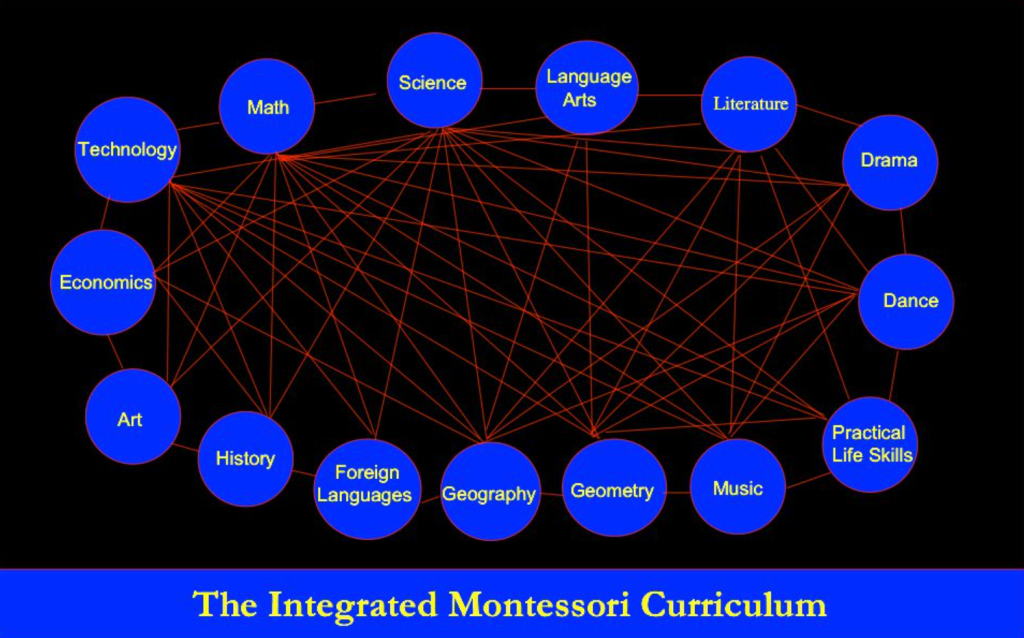
The Montessori curriculum is dynamic, interconnected, and deeply responsive to each child’s developmental needs. It’s not a list of lessons to check off: it’s a carefully designed framework that supports children from infancy through adolescence in becoming independent, curious, and capable learners.
So whether you’re launching a new school, refining your program, or simply looking to deepen your understanding of how it all fits together, this guide will walk you through the essentials of Montessori curriculum: what it includes, how it progresses, and why the materials matter so much.
What Is Montessori Curriculum, Really?
At its core, the Montessori curriculum is organized around five to ten key learning areas that develop progressively through hands-on, multi-sensory materials. Children advance at their own pace, guided by their individual development and interests rather than a rigid timeline.
But here’s what makes it different from traditional education: the curriculum isn’t just about academic content. It’s about cultivating the whole child: cognitively, socially, emotionally, and physically. Dr. Montessori understood that children learn best when they can touch, manipulate, and explore concepts in concrete ways before moving to abstraction.
Each learning area contains materials organized by increasing complexity. A child doesn’t move to multiplication until they’ve mastered quantity recognition and addition. They don’t write sentences until they’ve worked with the Moveable Alphabet and understand phonetic sounds. This is the beauty of scope and sequence in action.
Understanding Scope and Sequence
When we talk about scope and sequence, we’re referring to the bird’s-eye view of curriculum progression across all subject areas. The scope tells us what will be covered: the breadth of skills, concepts, and learning objectives. The sequence tells us when and in what order these elements are introduced.
In a Montessori setting, this isn’t about rigid timelines. A scope and sequence document shows the progression of skills within each learning area, but it acknowledges that children have varied interests and learning timelines. One child might spend months perfecting their work with the Pink Tower before moving to the Brown Stair. Another might breeze through and be ready for extensions within weeks.
This flexibility is essential, but it doesn’t mean we’re making it up as we go. A well-documented Montessori scope and sequence ensures that nothing gets missed and that each child receives comprehensive exposure to all areas of learning: even if they reach them in different orders or at different times.
Core Curriculum Areas: From Infant/Toddler to Elementary
Let’s break down the key areas that form the foundation of Montessori education across the levels.
Infant/Toddler (Birth to Age 3)
At this level, the curriculum focuses on developing independence, language, movement, and trust. Activities are simple but profound:
- Movement and coordination – crawling, walking, climbing, transferring objects
- Practical life – self-care activities like washing hands, dressing, food preparation
- Language – rich oral language exposure, naming objects, songs, and simple books
- Sensory exploration – textures, sounds, tastes, weights
The environment is carefully prepared with materials that invite exploration and support emerging skills. Everything is child-sized, accessible, and purposeful.
Primary (Ages 2.5 to 6)
This is where the classic Montessori curriculum really takes shape. The five core areas are:
Practical Life – This area develops concentration, coordination, independence, and a sense of social responsibility. Activities include pouring, spooning, sweeping, polishing, buttoning, and food preparation. These exercises may look simple, but they’re building the neural pathways for everything that comes next.
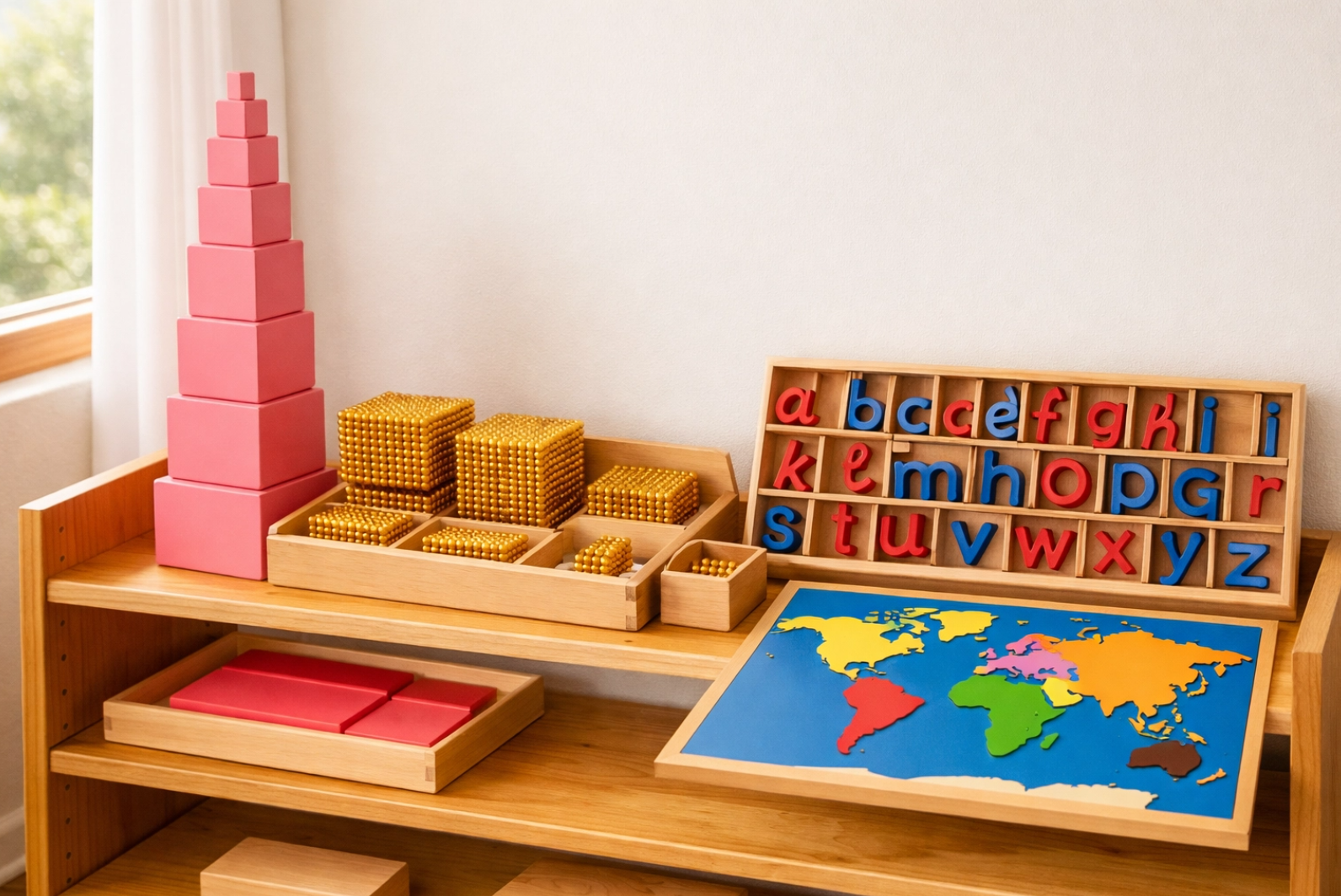
Sensorial – Children refine their perception through work with materials that isolate qualities like size, color, shape, texture, weight, sound, and temperature. The Pink Tower, Brown Stair, Color Tablets, and Sound Cylinders help children categorize and organize sensory information: a cognitive skill that extends far beyond the classroom.
Mathematics – Montessori math is breathtakingly concrete. Children work with golden beads to understand quantity and place value, then progress through the decimal system, operations, fractions, and eventually abstraction. The materials make abstract concepts tangible.
Language – Beginning with oral language and phonetic awareness, children move to Sandpaper Letters, the Moveable Alphabet, and eventually reading and writing. Grammar is introduced through hands-on materials like the Grammar Symbols, making parts of speech a tactile experience.
Culture – This broad area includes geography (puzzle maps, land and water forms), botany (leaf classification, plant care), zoology (animal classification), science experiments, history timelines, music, and art. It helps children understand their place in the world.
Elementary (Ages 6 to 12)
Elementary expands and deepens the curriculum with a focus on imagination, reasoning, and social collaboration. The core areas include:
- Language – Advanced reading comprehension, writing across genres, grammar, word study, and research skills
- Mathematics – Operations with larger numbers, fractions, decimals, percentages, geometry, algebra, and problem-solving
- Geometry – Explorations of plane and solid figures, symmetry, congruency, similarity, and spatial relationships
- Cultural Studies – History (timelines, civilizations, biographies), geography (physical and political studies), life sciences (botany, zoology, ecology), physical sciences (chemistry, physics, astronomy)
- The Arts – Music theory and performance, visual arts, drama, and creative expression
Elementary students work collaboratively on projects, conduct experiments, and engage in “going out” experiences to extend their learning beyond the classroom walls.
Why Montessori Materials Matter
Here’s a question I often hear: “Can’t we just teach these concepts with worksheets or digital tools?”
The short answer? Not really. Not if we want children to truly understand.
Montessori materials are not just teaching aids: they’re the curriculum itself. Each material is scientifically designed to isolate a single concept, provide hands-on exploration, and include a built-in control of error so children can self-correct without adult intervention.
Take the Binomial Cube, for example. At first glance, it’s a beautiful wooden puzzle. But it’s also a concrete representation of the algebraic formula (a+b)³. A Primary child explores it as a sensorial challenge. An Elementary child revisits it as an introduction to algebra. The same material, different levels of abstraction.
This is why having a comprehensive Montessori materials list and knowing the proper presentation sequence is critical. Without the materials, you don’t have Montessori: you have Montessori-inspired activities, which is not the same thing.
Implementing the Curriculum: What Educators Need to Know
So, how do you actually implement all of this in your classroom or school?
1. Observation is everything. Montessori educators must be skilled observers. You need to know where each child is in the scope and sequence, what they’re ready for next, and when to step back and let them work independently.
2. Prepare the environment meticulously. Materials should be complete, organized, and accessible. The classroom should invite exploration and support independence.
3. Document and assess progress. Use observation notes, checklists, and portfolios to track each child’s journey through the curriculum. This documentation is invaluable for parent conferences, accreditation, and your own planning.
4. Collaborate with colleagues. Especially in schools with multiple age levels, it’s essential that educators understand the continuum of learning. What happens in the Toddler room sets the stage for Primary. What happens in Primary lays the foundation for Elementary.
5. Seek ongoing professional development. The Montessori curriculum is rich and complex. Even experienced educators benefit from workshops, coaching, and continued study.
Resources and Support for Your School
At The Montessori Foundation, we understand that implementing and maintaining a strong Montessori curriculum requires support at every stage: whether you’re just starting out or you’re an established institution looking to strengthen your program.
We offer consulting and coaching services tailored to your school’s unique needs. From curriculum development and teacher training to leadership coaching and strategic planning, we’re here to help you build and sustain an authentic Montessori program.
Our professional development workshops cover everything from practical life presentations to advanced mathematics, ensuring your educators have the skills and confidence to guide children through the full scope and sequence. We also host leadership institutes for administrators and heads of school who want to deepen their understanding of Montessori philosophy and school management.
Whether you need a comprehensive curriculum review, help creating a scope and sequence document, or guidance on materials selection and classroom setup, we’re here to support your school’s success.
Bringing It All Together
The Montessori curriculum isn’t a mystery: it’s a carefully constructed pathway that honors each child’s development while ensuring comprehensive learning across all domains. Understanding the scope and sequence, respecting the role of materials, and committing to ongoing observation and professional growth are the keys to implementing it effectively.
If you’re ready to take your program to the next level, explore our consulting services and professional development opportunities or reach out to discuss how we can support your school’s unique journey.
The beauty of Montessori education is that it works: when it’s done with fidelity to Dr. Montessori’s vision and with the support educators need to succeed.
Leave a Reply